

How Can Muscle Loss Be Reduced as We Age?
Do you feel like your strength isn’t what it used to be? Climbing stairs feels like a workout, the shopping bags seem heavier every week, and keeping up with the
Before you dive in: this article takes about 10 minutes to read, as we’ve included everything you need to know about amino acids and why they might be important for you, too.
We aimed to cover all the essentials here, so it’s a bit on the longer side. Feel free to use the table of contents below for easier navigation.
People often ask me why I take amino acids when I’m not a bodybuilder. Those who spend time in the gym probably know a lot about protein supplements, and they’re likely familiar with amino acids too. For the rest of us, amino acids are usually just something to do with protein.

Everything we eat as “protein” (like meat, fish, eggs, dairy, peas, beans, and other plant proteins) is broken down by our body into tiny particles.
These particles are called amino acids, and breaking them down is important because the body then uses these amino acids to build countless cells. They become part of our muscles, bones, hormones, skin, hair, and even our nails.
How much amino acid we have available for these functions depends on our diet—that is, the quantity and quality of protein we consume daily.
There are many types of amino acids, but eight of them are “essential” because we can only get them from food.
We can consume other amino acids through food too, but if we get the right balance of these eight essential ones, our bodies can produce all the other amino acids from them. (Thank you, balanced diet!)

Common sense might tell us that if we eat plenty of protein, we’ll have all the nutrients we need. We’ll build muscle, have strong bones, keep our hormones and immune system in top shape, and grow healthy hair. But, unsurprisingly, it’s not quite that simple.
If you’re now wondering whether to reach for that bacon and egg breakfast, or get the meat ready for lunch, keep reading.
It’s something we might have learned in biology class, but who remembers? On average, an adult needs about 0.8 grams of protein per kilogram of body weight daily. Just multiply your weight by 0.8 to find your daily protein goal. Divide that by the number of meals you eat, and you’ll know how much protein you should aim for per meal.
But remember, this is just an average for a typical adult. If you do heavy physical work, exercise a lot, or have a long-term health condition, your needs might be different. So, choosing what to eat at the butcher’s depends on whether you’re fueling a 60-kg body or a 100-kg one.
In a way, yes – any protein will provide some amino acids and calories. But the body absorbs different protein sources in unique ways. That’s because proteins have varying digestion times, difficulties, and calorie contents (like fats, sugars, and carbs).

Not all the protein you eat is fully absorbed by your body. For instance, if you eat a big bucket of deep fried chicken, only part of it becomes usable amino acids for your body. The rest is digested as calories that you either burn off or store as fat.
To give some numbers: a typical daily menu contains around 40 grams of protein (depending on the type), which gives us about 10 grams of amino acids. But we actually need about 30 grams of amino acids each day—not protein, amino acids!
To get those 30 grams of amino acids, we’d need to eat about 120 grams of protein, which would be the daily amount for a 150-kg person! If you’re around 75 kg, that would mean you’re eating double the protein, and possibly double the calories, you actually need.
If you eat less protein (based on the calculation above), you might find you’re not getting enough (or enough quality) protein, and therefore, you’re not getting the building blocks your body needs.
People joke about “joining the slower lane” after 40, but there’s no need to feel worn out just because you’re getting older.
As we age, though, some body functions don’t work as well as they did 5-10 years ago. There are the obvious signs—like joints and muscles becoming less flexible. But there are also less noticeable, vital functions, such as protein digestion, which tends to decline after 40.
This simply means that while you might eat the same roast chicken every Sunday, as the years pass, your body will absorb fewer amino acids from it.
Let’s be real—most of us would say “yes” without hesitation. After all, protein is everywhere: roast meats, fried chicken, sausages, dairy products, and even plant-based proteins like peas and beans. Since we eat these quite often, we assume we’re getting enough protein.
But are you recognizing any signs of deficiency, even mild ones?
Not getting enough amino acids – also called a protein deficiency – can lead to all sorts of symptoms, from the mildly annoying to the seriously problematic.
Once one problem sets off a “domino effect”, it can trigger loads of other symptoms.
You might not have considered that these issues could actually be due to a lack of protein in your diet. Don’t worry, you’re not alone – this wasn’t exactly covered in school! Only recently has the science around this become better understood.
Fortunately, you’ve got options to help get the amino acids you need, but none of them come without a catch.
Protein powders are supplements you mix with water or milk, often taken before or after a workout. They’re convenient and come in various flavours, beyond the usual vanilla-chocolate-strawberry triangle (pistachio seems to have vanished, sadly!). On the downside, they often contain a lot of additives and have low absorption rates (more on this below). Also, don’t forget to count the calories.
If whey protein doesn’t agree with you, which can cause bloating or other digestive issues, there are options made from rice or peas. While these are sometimes easier on the digestive system, they can be less enjoyable due to their basic flavours and ‘grainy’ texture.
Popular protein powders – like whey – have a maximum absorption rate of about 16%, meaning that only around 16% of the protein you consume can be used by the body for building and repair. And the rest? It mostly just adds calories that you’ll need to work off.
Let’s break this down a bit so it’s clear. Take an average serving of protein powder – usually around 32 grams in total. This serving typically has about 24 grams of protein.
However, because whey (and most dairy-based proteins) have an amino acid absorption rate of only 16%, your body only gets around 3.84 grams of actual amino acids from that 24 grams of protein. Reminder: to stay in optimal health, you ideally need around 30 grams of amino acids daily.
These are mainly targeted at athletes and are generally taken before workouts to help with performance and muscle recovery. They’re effective in boosting strength and aiding recovery but contain only 3 out of the 8 essential amino acids. And even with BCAAs, only about 1% of what you consume is absorbed and used by the body for building protein.
Essential amino acid supplements provide all 8 necessary amino acids, or sometimes 9, as opinions differ on the importance of histidine. Histidine plays a key role in growth during childhood and also aids in post-exercise recovery. However, we can obtain histidine from food, and our bodies can produce it from the 8 truly essential amino acids.
A major advantage of essential amino acid supplements is that they don’t require digestion; they’re absorbed directly into the bloodstream, delivering instant effects without adding extra calories you’d later need to burn off. The only drawback is if the supplement has an imbalanced mix of amino acids or includes unwanted additives.
Your choice depends on your age, lifestyle, activity level, diet, and any existing health concerns.
We recommend BCAAs primarily for those who exercise regularly and are focused on performance and faster recovery. However, if you need comprehensive amino acid supplementation, BCAAs alone won’t be enough as they only contain 3 essential amino acids.
Whey or plant-based protein powders can be ideal for those who tolerate them well (without digestive issues) and who exercise or carefully manage their diet. Just be mindful of the calorie and additive intake that comes with these options.
Essential amino acids are the ‘joker’ in the deck, as they’re suitable for a range of needs—from boosting performance and recovery during workouts to fitting smoothly into a desk-bound, low-calorie lifestyle. The trick is all in the dosage. Tablet or capsule forms don’t add any extra calories, so there’s nothing extra to burn off.
In some cases, it might even be beneficial to combine different supplements to get the best results.
We can’t give you a definite answer. From our experience, doctors who have come across essential amino acids (usually through patients with serious illnesses) have been intrigued and eager to learn more.
We believe GPs are already stretched enough without needing to delve into every new supplement that comes along. If you happen to be a GP, please share your thoughts with us through our contact details!

Only as much as all chocolates are the same. We mean it in terms of quality, ingredients, and content.
First, you should check the ingredient list, especially for how many additives or auxiliary substances the product contains. It’s a matter of personal preference how important it is for you to limit these in your intake.
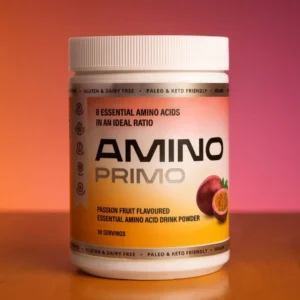
Amino Primo has been deliberately made to contain no other aids or additives, only the 8 essential amino acids.
Next, look at the total grams of essential amino acids contained in your chosen product. Generally, you will find that currently available products offer daily doses ranging from 3 to 6 grams. A box usually contains enough servings for 20 to 30 days, depending on the quantity.
For Amino Primo, the recommended daily dose is 2×5 tablets, meaning you can support your body with a daily total of 10 grams of essential amino acids for 30 days.
When we created Amino Primo, our goal was to develop a product that is utilised by the body as effectively as possible, meaning our bodies can build with it in the highest percentage with the least waste. For this to happen, the product must contain the 8 essential amino acids in the correct ratios and quantities.
To simplify, this is because when our bodies process proteins, they produce urea, uric acid, and ammonia, which our kidneys filter out. An ideally balanced amino acid product, however, doesn’t produce ammonia as a by-product, so it doesn’t strain the liver and kidneys.
Thanks to relentless development, Amino Primo can be utilised by the body at a rate of 99%, without unnecessary by-products that burden the liver and kidneys. (This figure is worth comparing to the utilisation rates of other protein supplements.)
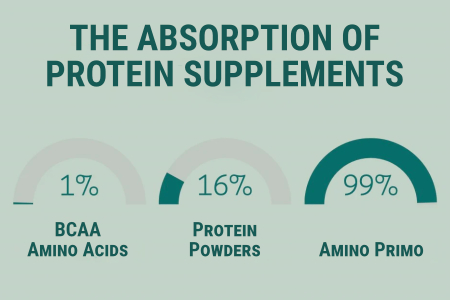
It is clear that if we take a supplement on a daily or weekly basis, the less strain it puts on our bodies, the better.
Moreover, Amino Primo’s essential amino acids are calorie-free, containing no sugar, fat, or artificial flavours, ensuring that you only intake what your body truly needs.
You can find the following customer feedback on our website, and you can read similar comments on our Facebook page. You’ll see that the effects of essential amino acids are incredibly wide-ranging, meaning that if you give your body what it needs, you can achieve outstanding results.
“I have greater endurance, better focus, higher capacity for effort, healthy joints, and an overall smoother-functioning body thanks to the ideal composition of Amino Primo. It really does contain what they say it does, and it truly has a great effect.”
“My diet was quite restricted due to digestive issues and a bile diet, but thanks to the amino acids, I didn’t become weak, and I didn’t lose muscle. I think it also sped up my healing process.”
“I lost 26.5 lbs before I started taking Amino Primo, but I didn’t feel healthy from it. Once I started taking the Amino, something fell into place, and the extra pounds didn’t come back; in fact, I have been losing weight at a healthy rate since then. My blood sugar level returned to normal; it was 5.9 during a blood test before I started taking the amino, and after taking it, I went for a check-up, and my morning blood sugar was 4.7. I feel physically better. I no longer have cravings and don’t feel the need to overeat.”
“I’m progressing better with my training; I no longer have muscle soreness like I used to, I’m getting toned faster, my skin looks better, my wrinkles have faded, and my hair, which has been a constant issue for ten years, is no longer falling out.”
“As soon as I started taking it (my husband ordered it for me), I felt its positive effects the very next morning. My teeth have always been very sensitive, and there wasn’t really a solution for that. Brushing my teeth used to be a struggle. Now I can take it in the morning without any issues for my stomach, and I can exercise immediately afterward without feeling burdened. My body has calmed down somehow because something was missing, and that has now been replenished.”
“I started taking it about 3-4 months ago; at first, I didn’t even take full daily doses, but I felt a change little by little. For instance, I eat less and less often without experiencing those hunger pangs. I feel satisfied more quickly and don’t need to eat so much at once; I drink more instead. Movement feels easier, I can put more load on my body, my muscles, and my movements are more confident. My muscle soreness goes away quicker. I feel my skin is smoother, my nails are stronger, and my hair is also stronger, with lots of baby hair starting to grow. My digestion has also become more balanced. I’m sure this isn’t the end, but I’ve already noticed these small changes.”






The Amino Primo essential amino acid supplement is gluten-free, lactose-free, sugar-free, and contains no additives or auxiliary substances. It absorbs in about 25 minutes, so your body can use it right away. You can freely experiment with the dosage; you can’t overdose, as any excess will leave your body through urine without overloading the liver or kidneys.
In short? Yes, you do.
But let’s ask the question differently: would you like to feel good in your own skin? Would you like to leave behind fatigue, sluggishness, or various physical symptoms? Then why not give yourself a chance for that?
Of course, we don’t claim that essential amino acids will solve all of your body’s problems immediately. Every body is unique, and everyone struggles with different symptoms, often for different reasons.
However, it’s definitely worth asking yourself how your body and health would change if you started providing yourself with as many nutrients as possible from now on.
share this article:

Do you feel like your strength isn’t what it used to be? Climbing stairs feels like a workout, the shopping bags seem heavier every week, and keeping up with the

Feeling exhausted after Christmas? It’s not laziness—it’s biology. Discover why festive habits drain your energy and what smart people are doing to recover faster in January.
Discount Applied Successfully!
Your savings have been added to the cart.
key bits & bobs...